
What Actually Makes a Chafing Dish "Luxury" vs Standard?
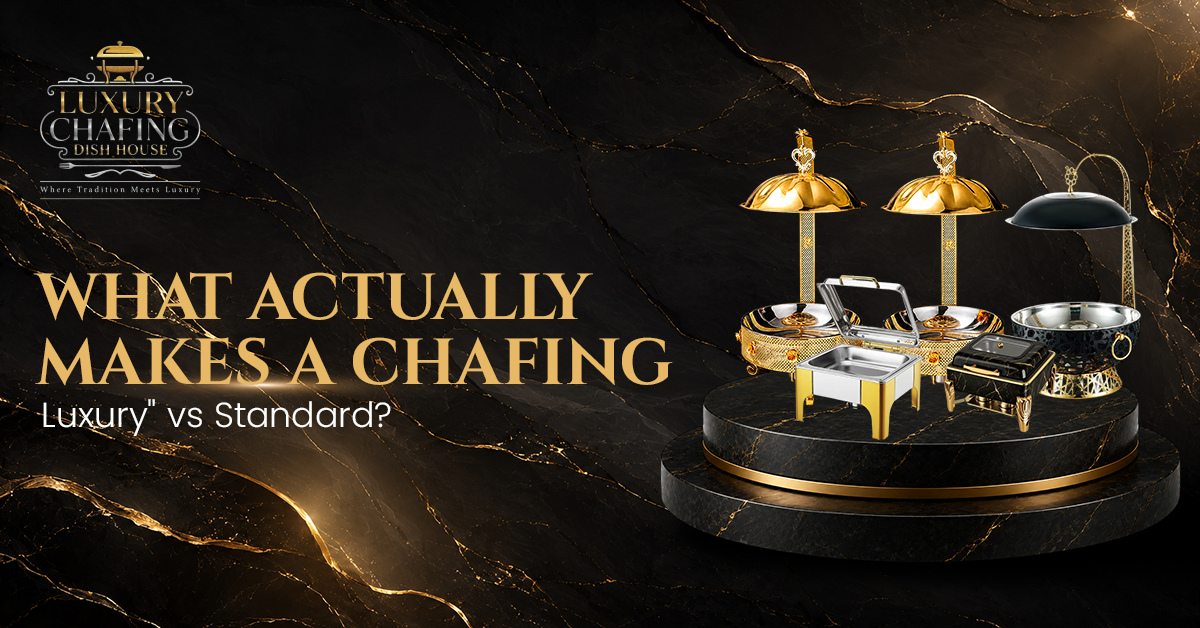
Put two chafing dishes side by side in a showroom and most people cannot tell them apart. Both are stainless steel. Both have a lid, a food pan, a water pan, and a frame. One costs $45 and one costs $145, and the honest question every buyer eventually asks is whether that gap buys anything real or just a nicer word on the listing.
It buys something real. But not always what people assume.
The word "luxury" gets applied loosely in this category, and plenty of sellers use it to mean nothing more than a gold-colored frame. Genuine luxury chafing dishes differ from standard ones in ways you can measure: alloy composition, steel gauge, weld quality, finish process, and hardware engineering. Some of those differences show up the moment you lift the unit. Others only reveal themselves in year three, when one set still photographs well and the other has pitted around the rim.
Here is what actually separates the tiers, from someone who has specified equipment for both.
It Starts With the Alloy, Not the Look
Every conversation about chafer quality begins with two numbers stamped somewhere in the spec sheet, if the seller publishes one at all.
Stainless steel used in food service is described by its chromium and nickel content. Chromium builds the passive layer, the self-healing chromium oxide film that resists rust. Nickel improves corrosion resistance, formability, and critically for this category, polishability. Nickel is what allows steel to take a true mirror finish.
Grade |
Chromium |
Nickel |
Corrosion Resistance |
Typical Tier |
|
18/10 (304) |
~18% |
~10% |
Highest of the three |
Luxury and premium |
|
18/8 (304) |
~18% |
~8% |
Excellent |
Mid-range commercial |
|
18/0 (430) |
~18% |
0% |
Lowest, no nickel |
Budget, high-turnover |
|
201 |
16 to 18% |
3.5 to 5.5% |
Moderate |
Economy |
The practical consequence is this: a 201 chafer looks nearly identical to a 304 chafer on day one. Under repeated washing, acidic foods, and chloride-based detergents, the 201 unit degrades visibly faster, particularly around welded joints and pan rims where the passive layer is already stressed. Grade 304 typically costs 30 to 50 percent more per unit than 201 at equivalent thickness, which explains a meaningful share of that price gap.
If a listing advertises a low price and does not specify 304, assume it is 201 or lower.
Gauge: The Difference You Feel Before You Measure
Alloy grade tells you what the metal is. Gauge tells you how much of it you are getting, and this is where the tiers separate most obviously.
Consumer-grade chafers typically run 0.4mm to 0.6mm in wall thickness. Commercial units run 0.8mm to 1.2mm and above. That sounds like a trivial difference until you understand what it changes:
Heat retention.
Thicker steel holds thermal mass. Food stays at serving temperature longer between fuel changes.
Warp resistance.
Thin pans distort under sustained heat and transfer temperature unevenly, creating hot spots that scorch food at the edges.
Dent resistance.
A 0.5mm frame dents when a server bumps it against a transport cart. That dent is permanent and it shows.
Perceived quality.
Weight communicates substance. Guests do not measure gauge, but they register the difference between a unit that feels solid and one that flexes when lifted.
Reputable suppliers will provide gauge specifications on request. A seller who cannot or will not tell you the wall thickness is telling you something.
Construction Details That Separate the Tiers
Beyond material, fabrication quality is where luxury earns its designation. These are the markers professionals check.
Feature |
Standard Chafer |
Luxury Chafer |
|
Welds |
Spot welds, visible seams |
TIG or laser welds, ground smooth |
|
Edges |
Cut edges, sometimes sharp |
Rolled and polished, no cut hazard |
|
Handle attachment |
Basic spot weld |
Riveted or welded, rated for full load |
|
Finish |
Basic polish, dulls quickly |
Mirror polish or electropolish, passivated |
|
Frame |
Lightweight, prone to wobble |
Reinforced, stable under full pan weight |
|
Lid mechanism |
Basic lift-off or simple hinge |
Hydraulic soft-close, or hand-formed decorative |
|
Feet |
Plain stamped legs |
Decorative cast or sculpted legs |
Two of these deserve elaboration.
Rolled edges.
A luxury chafer has its edges rolled and polished into smooth arcs rather than left as cut steel. This eliminates the finger cuts that occur during cleaning and handling, a genuine and frequently overlooked safety issue for catering staff who wash equipment at volume.
Passivation.
After fabrication, quality manufacturers chemically treat the steel to remove free iron from the surface and strengthen the passive layer. Passivated and electropolished surfaces resist corrosion better and clean more easily. It is invisible on the shelf and decisive over years of service.
If you want to understand how these components fit together as a system, our guide on what a chafing dish is and how it works covers the anatomy in detail.
Design as Function, Not Decoration
Here is where the luxury tier genuinely diverges rather than simply improving. Standard chafers are designed to be invisible. They exist to hold food at temperature and disappear behind the presentation. Luxury food warmers are designed to be looked at.
That distinction changes the engineering brief entirely. Once a chafer is a display object, form language matters: sculpted lids, hand-formed decorative elements, gold and rose gold accents, marble and wood-effect detailing, hanging frames that suspend the vessel above the table. Browse the luxury chafing dishes range and you will see pieces built around crescent moons, pearl detailing, orchid forms, and butterfly motifs. None of that exists on a $45 unit because a $45 unit is not trying to be seen.
The chafing dish with hanging format illustrates this well. Suspending the vessel from a decorative frame serves no thermal purpose whatsoever. It exists to create height and visual drama on a buffet line, and it turns a functional station into a centerpiece.
Material choice extends the same logic. The brass, copper, and silver chafing dish category exists because these metals carry associations that stainless steel does not, warmth, tradition, ceremony. They ask more of you in maintenance and they return more in presence.
What Luxury Does Not Mean
A few honest corrections, because overselling this category serves nobody.
Luxury does not always mean better heat retention.
A heavy-gauge 18/8 unit will outperform a thin, poorly fabricated 18/10 unit in almost any real test. Fabrication quality dominates alloy chemistry. Anyone telling you the grade number alone determines performance is oversimplifying.
Luxury does not mean maintenance-free.
Decorative finishes, plated accents, and brass or copper surfaces need more care than plain stainless, not less. A gold-accented chafer treated with abrasive pads will look worse after six months than a basic unit treated properly.
Luxury is not always the right purchase.
A high-turnover staff canteen or a rental operation where equipment gets handled roughly by strangers is often better served by durable mid-tier units bought in volume. Many hotels run a deliberate two-tier inventory: premium pieces in banquet and fine dining spaces, workhorse units in breakfast service and staff areas. That is a sound strategy, not a compromise.
A gold frame alone is not luxury.
Plating over thin 201 steel is cosmetic, and it is the most common way the word gets misused in this market.
Where the Price Actually Goes
For a buyer trying to justify the difference, here is the breakdown.
Cost Driver |
Adds Roughly |
What You Get |
|
304 over 201 alloy |
30 to 50% |
Corrosion resistance, polishability, lifespan |
|
Heavier gauge steel |
15 to 30% |
Heat retention, warp and dent resistance |
|
Hydraulic soft-close lid |
20 to 40% |
Silent service, reduced hinge wear, staff safety |
|
Mirror polish and passivation |
10 to 20% |
Sustained shine, easier cleaning, corrosion resistance |
|
Decorative design and finishing |
Varies widely |
Presentation value, brand impression |
The first four are performance investments with measurable returns. The fifth is a presentation investment, and whether it is worth it depends entirely on whether your guests see the equipment. For a hotel banquet operation or a wedding caterer whose photographs become marketing, it very often is.
Choosing Your Tier
Match the equipment to the room and the frequency of use.
Premium units make sense for wedding caterers, hotel banquet service, upscale event companies, and homeowners who entertain formally and want pieces that hold up across years. If open flame is restricted at your venues, electric chafing dishes offer the same build quality with thermostatic control. For high-volume service where speed matters more than ornament, roll top chafing dish models with hydraulic lids deliver the operational advantages without the decorative premium.
Standard units remain the right call for occasional home use, casual catering, budget-constrained operations, and any situation where equipment turnover is high enough that replacement is expected.
Frequently Asked Questions
What makes a chafing dish "luxury" rather than standard?
Four measurable things: 304 grade steel rather than 201, heavier gauge construction of 0.8mm or above, superior fabrication including smooth welds and rolled edges, and mirror-polished or passivated finishes. Decorative design and premium hardware such as hydraulic lids sit on top of that foundation.
Is 18/10 stainless steel actually better than 18/8 for chafing dishes?
Marginally. The extra nickel improves corrosion resistance and polishability, which matters for mirror-finished display pieces. In practice, gauge and fabrication quality affect real-world performance far more than the difference between these two grades.
Are luxury chafing dishes worth the extra cost?
For regular use, generally yes. Better alloy and heavier gauge translate to a longer service life, and for client-facing events the presentation value is a business asset. For occasional home use or high-turnover rental fleets, mid-tier units often make more financial sense.
Do luxury chafing dishes keep food warmer?
Usually, because heavier gauge steel holds more thermal mass and retains heat between fuel changes. But the advantage comes from thickness and build quality, not from the price tag or the decorative finish.
How can I tell if a chafing dish is 304 or 201
Ask for the specification in writing. Reputable sellers publish alloy grade and gauge. If a listing avoids the question or advertises an unusually low price without naming 304, treat it as 201 or lower.
Do premium finishes require more maintenance?
Gold-plated, brass, copper, and decorative surfaces need gentler care than plain stainless steel. Mild soap, soft cloths, thorough drying, and no abrasive pads or chlorine cleaners. Done properly, that routine takes minutes.
Should I buy all luxury pieces or mix tiers?
Mixing is standard practice in hospitality. Use premium units where guests see them and durable mid-tier units in back-of-house or high-turnover service. It protects presentation standards where they matter and controls replacement spend where they do not.
Buy for the Room You Are Serving
The right answer is not always the most expensive one. It is the one matched to how often you serve, who sees the equipment, and how long you need it to look the way it did on delivery.
If your buffet is part of the impression you sell, whether that is a wedding reception, a hotel banquet, or a table you set at home for people who matter, the build quality behind the shine is worth understanding before you buy. Explore the collection or contact our team with your venue type and service volume, and we will help you match the tier to the occasion.
